Water damage restoration in Doral, FL
Doral has the most repeat flood losses of the five municipalities on this site and the shallowest water, and only four of them are anybody's home. That combination changes what the work looks like. Tell us what happened and we will get you a free quote from a restoration contractor working here.
- Free quote
- Doral homes and premises
- No obligation
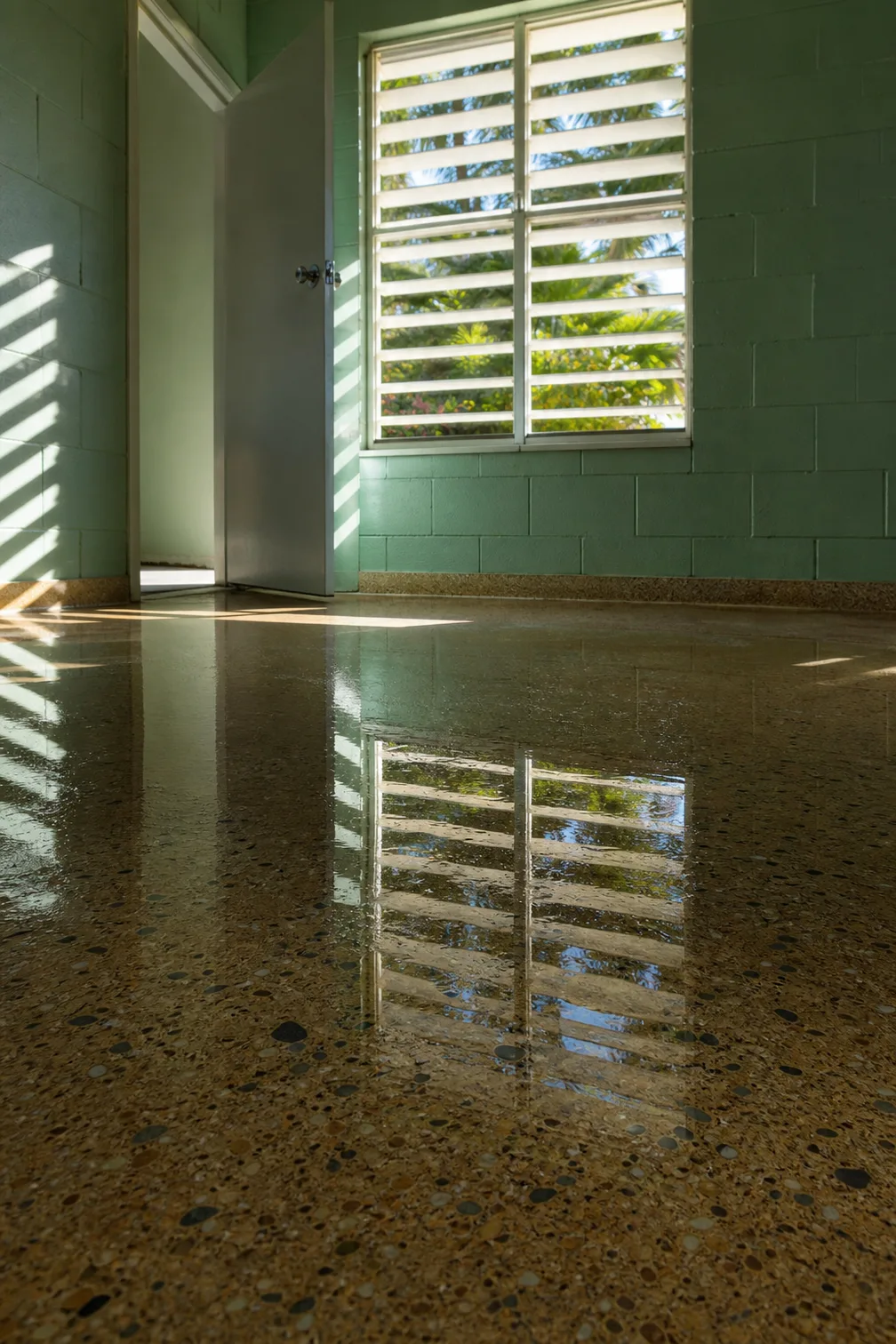
Two things make flooding in Doral different
The trade does not change across a city boundary. Water comes out, saturated material that will not dry comes out with it, and what is left is dried and cleaned according to what the water was carrying.
What does change is the shape of the typical job, and Doral's shape is different from every one of its neighbors on two counts at once. The water is shallower and the buildings are mostly not homes. Both of those change what the work costs and how long an owner can afford to wait.
An inch that does not drain
Miami-Dade County publishes what the letters on a flood map mean. Zone AE is "the flood insurance rate zone that corresponds with flood depths greater than three feet". Zone AH is "areas of shallow flooding with average depths between one and three feet". Both carry a mandatory flood insurance requirement on a federally backed mortgage.
Of the 61 properties FEMA lists in Doral as having flooded more than once, 46 are in zone AH. One is in zone AE. Six more are in AHB and eight are in zone X, outside the mapped high-risk area entirely.
Every other municipality on this site runs the other way. Miami Gardens has 27 of 28 in AE. Miami Lakes has all five in AE. Opa-locka is split roughly evenly. Doral is the ponding city.
Ponded water behaves differently from moving flood water, and the difference is duration rather than depth. The water arrives because rain has landed on ground that is already saturated and drainage that cannot discharge, so there is nowhere for it to go down to. It comes in under doors and around thresholds rather than through windows. And it leaves at the same speed it arrived, which means an inch here routinely sits for most of a day.
That duration is the whole story. Damage from standing water is a function of depth multiplied by time, and shallow water buys back none of the time. An inch that stood for eighteen hours against painted block, under racking or beneath a floor covering has put moisture into more of the building than four inches that drained away in an hour.
Four out of sixty-one
The other unusual figure in Doral's repeat-loss list is who is in the buildings. Only four of the 61 are primary residences. Eighteen are on the severe repetitive loss list, which is nearly a third of them and the highest share in this ring.
That is a statement about the properties on the list rather than about the city as a whole, and it is the most useful thing on this page for anybody responsible for premises here.
A flood in a house is measured in ruined possessions and somewhere to sleep. A flood in a unit is measured in stock, equipment, records and days closed, and the building fabric is often the smallest line in it. The restoration decisions follow from that. Getting a floor dry and back in service in four days rather than nine can be worth more than everything the drying costs, and a floor that is signed off dry because the schedule ran out rather than because the readings came down is a second closure in six weeks.
The fourth thing to ask for on premises
Ask for the same three things a homeowner should ask for, plus one.
A room-by-room or bay-by-bay list of what is being removed and what is being dried. A statement of which grade the water is being treated as. An explicit line between restoration and repair, because drying a wall and rebuilding it are normally two contracts.
The fourth is the drying target and how it will be evidenced. Ask for daily moisture readings on each affected material, and ask what unaffected material in the same building reads, because that is the number the affected material has to come back to. On premises where the floor is going back into service under load, that record is also the only defense against an argument later about whether it was dry when it was covered.
We do not do the work and we take nothing off the price of it. What you describe is passed to one restoration contractor covering Doral, who quotes it straight to you. On premises, ask for the license and the insurance certificate in writing before anything is agreed, because a lease usually requires you to hold copies anyway.
The discount that moved the right way
The National Flood Insurance Program's Community Rating System scores a city for floodplain management beyond the federal minimum and converts the score into a premium discount. Miami-Dade County's own mitigation strategy sets out the values: class 7 is 15% off inside a flood zone, class 6 is 20%.
That county document, published in July 2020, lists Doral at class 7. FEMA's current status book has the city at class 6.
Doral is the only one of the five municipalities on this site that has moved in that direction. Opa-locka has fallen from 8 to 10 and lost its discount altogether. Miami Gardens has slipped from 6 to 7. Miami Lakes has held at 6. Hialeah Gardens has never joined the scheme at all.
If you hold a flood policy on a Doral property and the premium has not reflected that improvement, the community class is worth raising with your agent explicitly, because the discount applies to the community rather than to the policyholder and is not always picked up at renewal without prompting.
It is also the newest of the five in program terms. FEMA records Doral entering the National Flood Insurance Program's regular phase on 12 May 2004, and joining the Community Rating System in May 2009, where its neighbors to the north and east have been in the program since September 1972. A city that has been scoring for fifteen years rather than fifty has more of the easy improvements still available to it, which is a reasonable way to read a class that has gone up while three of its neighbors went down or stood still.
Documenting a flood in premises rather than a house
The record an adjuster works from is made in the first hours, and on commercial premises there is more of it to make.
Photograph the water at its deepest in every bay, including the parts that look undamaged, and photograph the outside so there is a record of what the street was doing. Then photograph what the water reached at the level it reached it: the bottom shelf of racking, the base of a cabinet run, the underside of anything pallet-mounted. Depth against a known object is worth more than a number written down later.
Keep stock and equipment where they are until they have been listed, even when the instinct is to clear the floor and reopen. Anything moved before it is recorded becomes an argument about whether it was wet, and once it is in a dumpster neither side can settle that argument.
Zone X is not the same as no risk
Eight of the 61 repeat-loss properties here are in zone X, which is outside the mapped high-risk area. A property in zone X has no mandatory flood insurance requirement attached to a federally backed mortgage, so a large share of owners there hold no flood cover at all.
Miami-Dade County is direct about what that costs. Moderate-to-low risk areas "submit more than 20 percent of the NFIP claims and receive one-third of all disaster assistance for flooding". Miami Gardens puts the same point in one line of its own material: "25% of flooding occurs outside areas formally designated as being flood prone".
Eight properties in this city are the local proof of it. They were outside the line on the map and they flooded more than once anyway.
Where this job sits in the trade
A ponding loss enters the trade in an awkward place, because the water is shallow enough to look like a cleaning job and has usually been there long enough not to be one.
It is still emergency water extraction while any of it is standing, and the hour count on arrival is already high here by definition. Because it came from outside the building it is flood damage restoration rather than a supply-line job, which changes what is disposed of rather than dried.
Two variants route elsewhere. Water that rose back through a drain is sewage cleanup whatever its depth. Water that came through a ceiling from an upper floor or a roof is ceiling water damage repair.
And the long duration that makes ponding awkward is the same thing that sends it to mold remediation, a trade Florida licenses on its own statute. All five are on the services hub.
The wider site
The five jobs are on the services hub and the trade in general is on water damage restoration in Hialeah. North of here the water gets deeper and the losses become households rather than premises; those four municipalities are on service areas.
The most repeat losses in this ring, and the shallowest water
Two figures here run the opposite way from every other city on this site.
- FEMA community number
- 120041
- Properties FEMA lists as flooding more than once
- 61, the most of the five, and 18 are severe repetitive loss
- How many sit in zone AH
- 46 of 61, the shallow ponding category of one to three feet
- How many sit in the deeper zone AE
- 1 of 61
- How many are primary residences
- 4 of 61
- Community Rating System class
- Class 6 and a 20% discount now, improved from class 7 and 15% in 2019
FEMA multiple-loss property data and Miami-Dade County flood zone definitions, read 31 August 2026.
Doral flooding questions
-
Is Doral in a flood zone?
Much of it is, and the category is unusual for this part of the county. Of the 61 properties FEMA lists here as having flooded more than once, 46 are in zone AH and only one is in zone AE.
Miami-Dade County publishes the definitions. Zone AH is "areas of shallow flooding with average depths between one and three feet", while AE "corresponds with flood depths greater than three feet". Every other municipality in this ring is dominated by AE. Doral is not.
-
How are floods cleaned up when the water is only an inch deep?
In the same order as a deep one, and the order matters more rather than less. The water is extracted, then anything porous it soaked into comes out, then the remaining structure is dried with readings taken until it matches unaffected material.
What shallow water changes is the boundary of the job. At an inch, the floor covering, the bottom few inches of every wall lining and the base of every cabinet and rack are wet and almost nothing above knee height is. The demolition is a horizontal band rather than a room, which is faster and easier to underestimate.
-
Does an inch of water really need a contractor?
It depends entirely on how long it sat. An inch that was pushed out in an hour off sealed tile often does not. An inch that stood overnight against block walls, under racking or beneath a floor covering has put moisture into material that will not release it from the room side.
Ponded water sits by definition. It arrives slowly because the ground cannot take it and it leaves slowly for the same reason, so the duration in zone AH is usually longer than the depth suggests.
-
Is water damage restoration worth it for a commercial unit?
The calculation is different from a house and usually turns on time rather than on the building. Structural drying in place is normally cheaper and faster than replacement, and the reason to do it properly is that undried material inside a wall becomes a second job in a few weeks, in an occupied unit, with stock back on the floor.
Only four of the 61 repeat-loss properties in this city are primary residences, so most flood losses here land on premises rather than on households. That means stock, equipment, records and the floor itself are usually the expensive part rather than the building fabric.
-
Who is responsible if I lease the unit?
Ordinarily the building is the landlord's and everything you put in it is yours, but the lease decides, and commercial leases vary far more than residential ones. Some make the tenant responsible for the interior finish as well.
Read the lease before agreeing to any work, because a tenant who commissions restoration on a landlord's building can find the invoice is not recoverable. Photograph everything either way, on the day, before anything is moved.
-
Why did Doral's flood insurance discount get better?
Because the city's floodplain management scored higher. Miami-Dade County's July 2020 mitigation strategy lists Doral at Community Rating System class 7. FEMA's current status book has the city at class 6.
The county sets out what that is worth: class 7 is a 15% discount inside the flood zone and class 6 is 20%. Doral is the only one of the five municipalities on this site whose class has moved in the favorable direction.
North of here, three different pictures
Doral's neighbors have deeper water, fewer claims and, in one case, no discount at all.
- Hialeah Gardens
Directly north, on the same class-6 discount but with no community rating behind it at all.
- Miami Lakes
Further north in the C-8 basin, with five repeat-loss properties against this city's sixty-one.
- Miami Gardens
Northeast, where the repeat losses are deep water and almost all of them are occupied homes.
Get a water damage quote in Doral
Tell us how deep the water got, how long it sat and what it reached. One restoration contractor working in this city will price it and contact you directly.
Serving Hialeah and Miami-Dade County.