Flood damage restoration in Hialeah, FL
Flood damage restoration is what follows once storm water has been inside the walls and the floor. Tell us what came in and how far it reached, and we will get you a quote from a restoration contractor working in Hialeah.
- Free quote
- Storm and rainfall damage
- Miami-Dade County
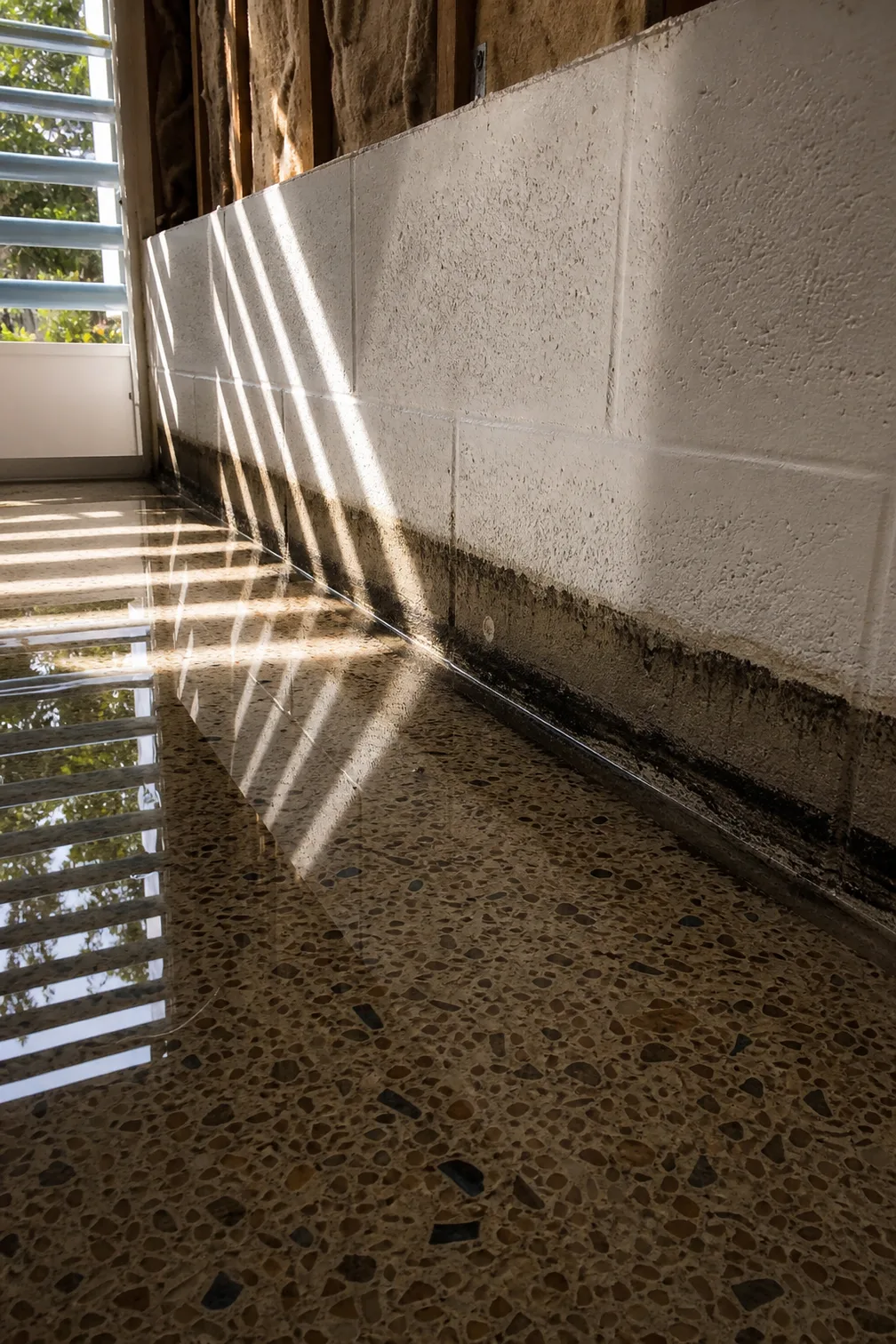
What flood damage restoration in Hialeah, FL involves
Flood damage restoration is the work that follows once outside water has been inside a building. It starts after the water has gone, and it is a different piece of work from getting the water out, which is covered on water extraction.
The order is fixed by what the water carried. Storm water that crossed a yard, a swale or a street picked up soil, fertiliser, whatever was in the road and sometimes whatever was in a drain. That is why the first decision on a flood job is not how to dry the house. It is what comes out of it.
Once the removal is settled, the rest follows a familiar shape: clean the hard surfaces that stayed, dry what is left, then rebuild. What makes a flood job expensive is almost never the drying. It is the quantity of material that has to be cut out and replaced before the drying can start.
Flood water is graded before anything is dried
A restoration contractor grades water by what is in it before they decide how to handle it. Clean supply water is one thing. Water that has picked up contaminants along the way is another. Water carrying sewage is a third, and it has its own rules, which are on sewage cleanup.
Storm water that entered a house at ground level is treated as the middle grade at best, and as the third if the street drainage backed up into it. That grading decides three things at once: what gets thrown away, whether cleaning happens before drying, and what protective equipment is on site.
It also decides what a homeowner should not do. Running a fan across contaminated water before it has been cleaned moves whatever was in it into the air of the rest of the house. The order matters more than the speed.
Flood damage repair: what comes out, and what stays
The reliable rule in a house built like a Hialeah house is that the hard structure stays and the soft contents of the wall do not.
Concrete block, the slab and tile set in mortar tolerate a short flood. They are dense, they do not hold organic material, and they can be cleaned and dried in place. That is a real advantage over housing stock elsewhere, and it is the reason a flood at this depth is often less destructive here than the same depth in a timber-framed house.
What does not survive is anything porous and organic that sat in the water. Drywall wicks upward well past the visible line, so a flood four inches deep usually means a cut at twelve or sixteen inches rather than at four. Batt insulation inside a wall holds water indefinitely and has to come out. Particle board and MDF cabinet bases swell and do not recover. Laminate flooring delaminates. Carpet padding is discarded rather than cleaned.
Solid hardwood is the interesting case. It can sometimes be dried in place with specialist mats rather than replaced, and it is worth asking the contractor whether they are quoting a rescue or a replacement, because the two numbers are far apart.
Hurricane damage repair, and the water half of it
Wind and water arrive together and get repaired by different trades. This site covers the water: intrusion, saturation, drying and the finishes that follow. Roof covering, structural framing and windows are a different contractor's work and we do not quote them.
That split matters when a claim is being written, because the two halves are often assessed separately. A roof that let water in is one line item; the wet ceiling, the wet insulation above it and the wet floor two rooms away are another. If a ceiling has been stained by water coming in from above, the drying sequence is set out on ceiling water damage repair.
Timing here is a fact about the calendar rather than a selling point. The National Hurricane Center records that the Atlantic hurricane season runs from June 1 to November 30, and that on the 1991 to 2020 climate period an average season produces 14 named storms, 7 hurricanes and 3 major hurricanes. The first hurricane typically forms in early to mid-August.
The practical use of that is preparation rather than urgency. The cheapest time to find out how a house handles water is a dry afternoon in April, not the evening the water arrives.
Storm water intrusion without a named storm
Most water that gets into a house in this city does not arrive with a name on it, and the city's own explanation of why is the most specific thing published about local flooding.
The City of Hialeah's local flood hazard page describes the ground the city sits on:
The City of Hialeah is located in a flat, low-lying area of Miami-Dade County. ... Our groundwater is also just below the ground surface. During the rainy season, canals and lakes are frequently full of water, and the groundwater table is full and close to the surface. ... When intense rainfall occurs during the rainy season, stormwater runoff may have nowhere to drain.
Three things in that paragraph decide what happens at a front door. On flat ground water does not run away from a house, it stands against it. A high water table leaves the soil under the slab already holding as much as it can take. And when the canals are full, the drainage system that would otherwise carry the runoff has no capacity left before the rain even starts.
The city also names two past events that produced widespread flooding rather than isolated damage: Hurricane Irene in 1999 and the unnamed storm of October 2000. Neither is recent, which is the point worth taking from it. A property with no flood history has a flood risk anyway.
Flood cover is a separate policy, and it starts 30 days late
This is the part of a flood that catches people after the water has gone, and it is decided long before the storm.
The City of Hialeah states plainly on its flood protection page that most standard homeowner policies do not cover flood damage. The city is an active participant in the National Flood Insurance Program, which is what allows residents to buy separate flood cover through private insurers or independent property and casualty agents in Florida.
Then comes the line that cannot be worked around:
Keep in mind that policies generally take 30 days to go into effect, so it's important to plan ahead.
A flood policy bought when a storm is already in the forecast does not cover that storm. That single fact is worth more to a Hialeah homeowner in May than anything else on this page, and it is why this page is written to be read outside the season as well as during it.
Two further points follow from it. The flood zone a property sits in changes the premium, and the zone is a matter of published record rather than opinion. And water from a burst pipe inside the house is not a flood in insurance terms at all, so it falls under a different part of a different policy. If the water came from inside, the extraction page is the right starting point rather than this one.
When a flood becomes a mold job
A flood that is cleaned and dried within a couple of days usually ends as a flood. One that sits, or one that was dried without the wet material being removed first, tends to come back as something else.
The trigger is time and organic material together. Wet drywall paper, wet insulation and a warm closed room are the conditions mold needs, and this climate supplies the warmth without being asked. When growth has already started, the job changes shape and is governed by different rules, including a Florida licensing statute. That is set out on mold remediation.
The way to keep a flood a flood is unglamorous: remove the wet organic material early, dry what stays with equipment rather than with open windows, and keep the readings until they stop moving.
Where to go next
Two questions tend to arrive after the water is out rather than during. The first is mold, because floodwater sits in insulation and behind baseboards long enough to start it, and remediation in Florida is a licensed trade priced on its own terms. Our guide to what a Florida mold job costs covers the four things that move the figure. The second only applies to condominiums, where a storm that entered through the building envelope raises the allocation question before the repair one; our condo water damage guide sets out how that generally divides between the association and the unit owner.
The whole trade is on water damage restoration in Hialeah, and the other four jobs are listed on the services hub. If your property is in one of the neighboring municipalities, Miami Lakes has its own page and the rest are on service areas.
What Hialeah homeowners ask after a storm
-
Can a house be repaired after a flood?
Almost always, and the question that decides the cost is not whether but how much comes out first. Concrete block, the slab, framing and tile generally survive a flood that drains within a day or two. Insulation, particle board, laminate and the paper face of drywall generally do not.
A quote that keeps everything and dries it is cheaper on paper and often more expensive by the end, because the material that was left in place has to come out on the second visit.
-
How much does it cost to repair flood damage?
The two numbers that move it most are depth and duration. Water that rose four inches and drained the same afternoon is a different job from water that rose four inches and sat for two days, even though the line on the wall is identical.
After that it is the count of rooms, the flooring type, and whether the lower wall has to be opened. Send photographs with a tape measure or something of known height in the frame and the estimate gets far closer.
-
What is the difference between remediation and restoration?
Remediation is the removal side. It takes out the water, the ruined material and any contamination, and leaves the building dry and clean but unfinished.
Restoration is the rebuild: drywall, trim, paint, flooring. Some firms quote both, some quote only the first, and the two documents look similar enough that people sign for one thinking they bought the other.
-
Does my homeowners insurance cover flood damage?
Standard homeowner policies in Florida generally exclude flood. The City of Hialeah says so directly on its own flood protection page, and the city takes part in the National Flood Insurance Program so that residents can buy separate cover.
Two details matter on the day. A new flood policy generally takes 30 days to take effect, so it cannot be bought during a storm watch. And water that came from a burst pipe inside the house is not a flood at all, which is a different section of a different policy.
-
When is flooding most likely in Hialeah?
The Atlantic hurricane season runs from June 1 to November 30, according to the National Hurricane Center, and its own climatology puts the first hurricane in early to mid-August in an average year.
Named storms are not the only cause here. The city's flood record points at heavy rainfall on flat ground with a high water table, which does not need a storm to have a name.
-
The water has drained on its own. Do I still need anyone?
Draining and drying are different events. Once the visible water has gone the material it soaked into is still holding it, and in this climate the surrounding air is not going to take it back out quickly.
The useful test is not whether the floor looks dry. It is whether a meter reading taken through the floor and at the base of the wall is falling day on day.
Get a quote for flood damage restoration
Describe what the water reached and we will pass it to one restoration contractor working in this city. The quote costs nothing and commits you to nothing.
Serving Hialeah and Miami-Dade County.