Water extraction in Hialeah, FL
Water extraction is the first job after a pipe fails or water gets into the house. Tell us what happened and we will get you a quote from a restoration contractor working in Hialeah, before any work starts.
- Free quote
- No obligation
- Hialeah and Miami-Dade
What water extraction in Hialeah, FL actually removes
Water extraction is the removal of standing and absorbed water from a building after a supply line fails, an appliance hose lets go, a drain backs up or storm water gets inside. It is the first of four stages, and it is the one with a deadline attached to it.
The visible part is quick. A truck-mounted or portable extractor pulls the pool off the floor, and a wet vacuum takes what is left in the corners and along the skirting. The part that takes longer is the water that has already gone somewhere you cannot see it: into the underside of a tile bed, along the joint between the slab and the block wall, into the base of a kitchen cabinet, under the vinyl in a hallway.
That hidden water is why extraction and drying are two separate line items on a quote. Taking the pool away does not end the event. It stops it getting worse.
Standing water removal in a house built on a slab
Houses here sit on a concrete slab. There is no floor cavity underneath for water to drain into, so it does what water does on a flat plane: it spreads sideways until something stops it.
That has three practical consequences, and they are the reason a Hialeah job does not look like the same job somewhere else.
The wetted area is wider than the leak suggests. A supply line under a kitchen sink can put water into a hallway two rooms away, following the fall of a slab poured decades ago. Contractors work outward from the source with a moisture meter rather than guessing at a boundary.
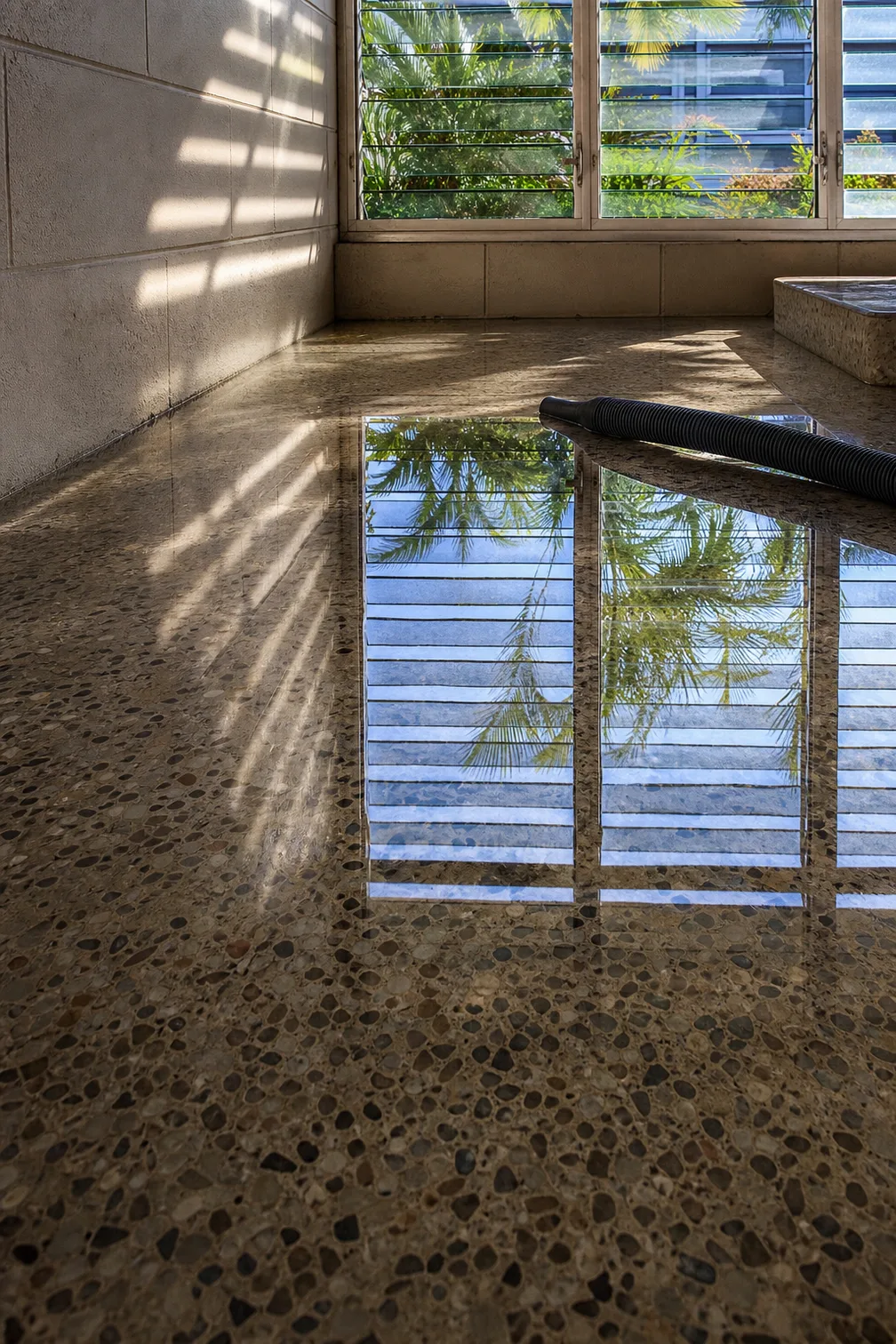
Terrazzo and ceramic tile hold up well and hide everything. The surface will look dry within a day while the mortar bed underneath is still holding water, and the tile is what is stopping it evaporating. Readings taken through the floor, not off it, are what settle the question.
Concrete block walls wick. Painted block absorbs water at its base and carries it upward, and a wall that looks fine at eye level can be wet for the lowest foot. The drying plan has to include the wall, not only the floor.
The first day, and what the clock is actually about
The number quoted everywhere in this trade is 24 hours. It comes from a real source. The Environmental Protection Agency's flood cleanup guidance states that mold can grow on wood, drywall, carpet and furniture if they remain wet for more than 24 hours.
The same agency puts the useful half of that the other way round. Its brief guide to mold and moisture says that where wet or damp materials are dried within 24 to 48 hours of a leak or a spill, in most cases mold will not grow. That is the window a contractor is working inside, and it is why the first call matters more than the third.
That is a statement about materials, not a marketing promise. It does not mean a house is ruined on the second day. It means the cost of the job changes shape once organic material has been wet for a day, because drying a wet wall and remediating a growing one are different pieces of work with different prices.
In this climate the margin is thinner than the figure suggests. Indoor humidity sits high through the wet season, so a house with the power out and the windows shut is not drying on its own. A closed-up room with water on the floor gets warmer and more humid, not drier.
Before anyone arrives, three things help and cost nothing. Shut the supply off at the meter if the water is still coming. Photograph every room the water reached, including the floor, the bottom of the walls and inside the cabinets. Then move what you can lift onto something dry.
Flood cleanup after a Hialeah storm
Storm water in a house is the same removal job with an extra question in front of it: what was in the water when it came in.
Rain that came through a failed window or an open door is clean when it starts. Water that ran across a yard, through a swale or over a street before it reached the door is not, and that is the common case here during a heavy rainfall event. It carries whatever the ground carried.
For flood cleanup the sequence changes. Materials that soaked up outside water come out rather than being dried in place, because drying does not remove what was dissolved in it. Hard surfaces get cleaned before they get dried. Only then does the drying equipment go in, and it is drying a smaller amount of material than it would have been.
If the water came in from outside during a named storm, the job is usually larger than extraction alone, and flood damage restoration is the page that covers what happens after the water is out.
Structural drying is a separate stage with its own equipment
Extraction is measured in hours. Structural drying is measured in days.
Air movers push air across wet surfaces so the water at the surface evaporates faster. Dehumidifiers take that water back out of the air and drop it in a bucket or down a drain. Both have to run together. Air movers alone in a closed Florida house just move humid air around, and a dehumidifier alone dries the air without pulling anything out of the floor.
A contractor doing this properly leaves a record: which rooms had equipment, what the moisture readings were on each visit, and what the readings were when the equipment came out. Ask for it. If a job later becomes an insurance claim, that record is the evidence that the drying was finished rather than abandoned.
Equipment days are also where quotes diverge most. Two contractors can agree on the extraction and disagree by several hundred dollars on drying, because one has planned four days and the other has planned seven.
What a flooded house cleanup costs, and what moves the number
There is no honest flat price for this work, and a site that publishes one is publishing a number it will not stand behind.
Five things move the figure. The area of floor the water actually reached, which is nearly always larger than the room it started in. The number of separate rooms involved, because each one needs its own equipment. What the floor is made of, since tile over a mortar bed, laminate and hardwood dry at different rates and some of them do not dry at all. Whether the lower part of the wall has to come out. And how many days the equipment stays.
The one thing that reliably makes a quote worse is a delay in describing it. Photographs taken on the first day, before anything was moved, are worth more than a paragraph written a week later.
What the city's leak credit is worth after a supply line fails
Most of this page is about the damage. This part is about the bill, and it is specific to Hialeah rather than to Miami-Dade generally.
The City of Hialeah runs its own water and sewer utility through the Department of Public Works, so a leak on your side of the meter is dealt with by the city rather than by the county. The city will consider a leak credit against the volume the meter recorded while the pipe was open.
The published conditions are worth knowing on the day the leak happens, because one of them is a deadline:
Request must be submitted within 30 days of billing date. Once request has been initiated and acknowledged by the Department of Public Works, customer has 6 months from acknowledgment date to submit all paperwork for review and approval.
The paperwork is a customer affidavit, notarised, with either a plumber's receipt or a notarised statement from whoever did the repair together with receipts for the parts, plus a $25 non-refundable inspection fee. There are two versions of the affidavit and picking the right one matters: one is for water that entered the city sewer system, the other for water that did not. A pipe that failed under a slab and soaked into the ground is the second case, and it is the one most people fill in wrongly.
None of that is restoration work and none of it is something we handle. It is money you can get back that has nothing to do with your insurance claim, and the 30 day window starts before most people have finished drying the house.
Where this job sits next to the others
Extraction is the first hour of a longer sequence. Which page you want next depends on what the water did.
If the water came from above and left a stain on a ceiling, start with ceiling water damage repair. If it was not clean water, read sewage cleanup before anything else, because the handling rules change before the drying does.
Extraction is also the stage that decides whether the next job exists. Water left in a wall cavity in this climate is a mold problem in a few days rather than a few weeks, and mold is a licensed trade in Florida with its own pricing and its own paperwork. Our guide to what a Florida mold job costs explains why that work arrives as two separate invoices, which is the part people are not expecting.
If the property is a condominium, there is a question that comes before all of this: whether the association or the unit owner is paying for the extraction at all. Our condo water damage guide sets out how the Condominium Act generally splits it and what to record on the first day, while the pumps are still running.
The full set is on the services hub, and water damage restoration in Hialeah is the overview page for the whole trade. We cover the surrounding municipalities as well, including Hialeah Gardens, and the rest are listed on the service areas page.
Questions Hialeah homeowners ask about water removal
-
What does water damage restoration include?
Four stages, in order. Extraction takes the standing water out. Removal takes out the materials that will not dry, which is usually soaked insulation, particle board and the bottom of the drywall. Drying pulls the remaining moisture out of what is staying, using air movers and dehumidifiers. Repair puts back what was removed.
A quote for the first three is a different document from a quote for the fourth. Ask which one you are looking at.
-
How long does it take to dry out walls from water damage?
Days rather than hours, and the number depends on what the wall is made of. A painted concrete block wall holds water differently from a stud wall with drywall on it, and a wall with vinyl wallpaper or a tiled face dries from one side only.
The contractor should be taking moisture readings rather than deciding by eye, and the readings should be going down between visits. If they are flat for two days, something is still wet behind the surface.
-
Can I do water restoration myself?
Clean water from a supply line, caught quickly, over a small area of hard floor, is within reach of a wet vacuum and a fan. Two things move it out of reach: how far the water traveled, and what was in it.
Water that came up through a floor drain or back through a toilet is a different job with a different set of rules, and it is covered on our sewage cleanup page.
-
What does 24 hour water damage restoration mean?
In this trade the phrase describes a contractor who takes emergency calls outside business hours. It is a claim about their staffing, not about ours.
This site is a quote form. Requests are read and passed on to one contractor, and the contractor sets their own hours. If water is moving through your house right now, shut the supply off at the meter and call a plumber first.
-
Will my water bill go up after a leak, and can I get any of it back?
It usually does, because the meter counted every gallon that escaped. The City of Hialeah runs its own water and sewer utility and it will consider a leak credit on the bill.
The request has to be made within 30 days of the billing date, and there are two different affidavits depending on whether the leaked water reached the sewer.
-
How much does water extraction cost in Hialeah?
Nobody can price it from a description. The figure moves with the area of floor affected, how many rooms the water reached, what the flooring and the lower walls are made of, and how many days of drying equipment the job needs.
What a quote should tell you is which of those the contractor has priced and which they have left open. Send photographs and you will get a number that means something.
Get a quote for water extraction in Hialeah
Send what you know about the water and we will pass it to one restoration contractor working in the city. There is no charge for the quote and nothing to sign.
Serving Hialeah and Miami-Dade County.