Water damage restoration in Opa-locka, FL
Opa-locka is a small city with a drainage problem its own government has written down, and a flood insurance rating that has moved the wrong way since 2019. Tell us what the water did and we will get you a quote from a restoration contractor working in this part of Miami-Dade.
- Free quote
- Opa-locka properties
- No obligation
What water damage restoration in Opa-locka, FL actually involves
Restoration is one trade with several jobs inside it, and which job you have depends on where the water came from and what it was carrying. That does not change from one side of a city line to the other. What does change here is everything around it: which flood zone the property sits in, whether your policy carries a community discount, who issues the permit for the repair, and how long the street outside holds water after a heavy afternoon.
Opa-locka residents get a version of this that is unusual even inside Miami-Dade. The city has written its own drainage problem down in some detail, and its standing in the federal flood insurance program has moved backward while its neighbors' moved forward. Both of those affect what happens after water gets into a house, and neither is something a restoration contractor can tell you.
The city's own account of why the water stands
The most direct statement about flooding in Opa-locka is the city's, in the material it publishes about its Stormwater Master Plan. It describes a drainage system made of canals, swales, storm sewers and exfiltration systems, and it does not describe them favorably. In the city's words those facilities are "in many instances aged, under-sized, damaged and non-functional to meet current and future levels of service", and the system as a whole is "a number of independently built facilities rather than an integrated network".
The consequence is stated just as plainly. The city records "persistent and significant flooding that occurs during periods of light to moderate rainfall events", with the worst of it on roadways in the commercial and industrial areas, where standing water has been compromising the pavement itself.
That sentence is worth reading twice, because of the words "light to moderate". Most flood material in South Florida is written about hurricanes and named storms. This is a city saying that an ordinary wet afternoon puts water where it should not be. Work on a citywide master plan and capital improvement plan started in September 2020 for exactly that reason.
For a homeowner it sets the expectation. If your street holds water in a normal summer downpour, that is a documented condition rather than a surprise, and it is worth knowing which of your rooms sit lowest relative to the road.
The rating change, and what it costs
The National Flood Insurance Program runs a voluntary scheme called the Community Rating System. A city that does more than the minimum on floodplain management earns a class number, and Miami-Dade County's own mitigation strategy explains the effect: classifications "range from 1 to 10 and they determine the premium discount for eligible flood insurance policies". Class 5 is a 25% discount inside a flood zone. Class 7 is 15%. Class 8 is 10%. Class 10 is nothing.
In that county document, published July 2020, Opa-locka is listed at class 8. In FEMA's current Community Status Book the city is class 10, and the discount fields are empty.
Nothing about a house changes when that happens. The same building, the same elevation, the same contents, the same owner, and a bill that is 10% higher than it was. The class is set by the city's floodplain management program, and a householder has no way to affect it and usually no way to find out it moved.
It is worth checking your own renewal against it. If you have held a policy here since before 2020 and the premium moved without your claims history moving, the community class is the first place to look.
Twenty-seven properties the federal program already knows about
FEMA keeps a list of properties that have made more than one flood claim, and publishes it in aggregate by community. Opa-locka has 27 on it. Eight of those are on the severe repetitive loss list, which is the narrower category for properties that have flooded repeatedly and expensively.
The addresses are not published and this page does not have them. What the aggregate is good for is calibration. Twenty-seven repeat-claim properties in a city this size is not a handful of unlucky houses, and it means the drainage the city describes is producing losses somebody has already paid for.
The zone split inside that group is the more useful part. Twelve are in zone AH, which is the shallow ponding category, one to three feet. Eleven are in zone AE, where mapped depths are greater than three feet. One is in unnumbered zone A. And three are in zone X, which is outside the mapped high-risk area entirely.
Those last three are the ones to think about. Being outside the mapped area removes the obligation to carry flood cover that comes with a federally backed mortgage, so households there frequently hold none, and these three have claimed twice anyway. Miami Gardens puts the general form of it in a single line of its own flood material: "25% of flooding occurs outside areas formally designated as being flood prone".
Ponding is a different problem from a river
The distinction between zone AH and zone AE is not a severity scale, and reading it as one leads people to the wrong preparation. Miami-Dade County's published definitions put AH at shallow flooding one to three feet deep, and AE at depths greater than three feet.
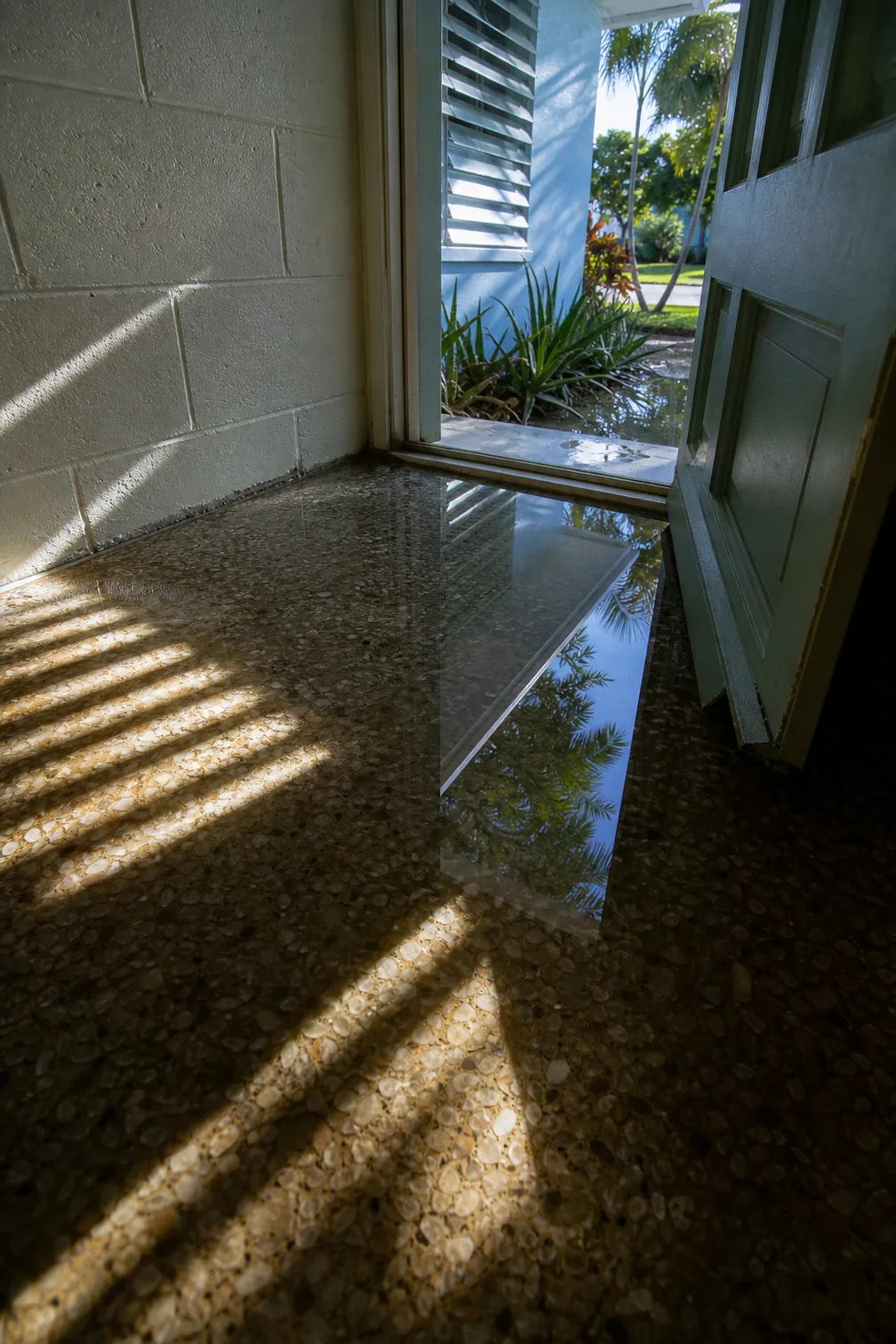
The physical difference is how the water behaves. Ponding water arrives slowly, sits, and leaves slowly, because there is nowhere for it to drain to and the water table underneath is already full. It comes in under doors and through wall vents rather than through windows, it is often only an inch or two inside the house, and it can sit for a day.
That is a drying problem more than a demolition problem, but only if it is caught early. An inch of water that stood for eighteen hours against a painted block wall and a run of cabinet bases has soaked into more of the building than an afternoon of it would.
What a quote for an Opa-locka property should tell you
A restoration quote is not a repair estimate and should not read like one. What it is pricing is the removal of water and wet material, the drying of what stays, and the cleaning that goes with whichever grade of water arrived.
Three things separate a useful quote from a number.
It should say what is being removed and what is being dried, item by item, so you can see which decisions have already been taken. It should say what grade the water was treated as, because water that came in off a street is not treated the same way as water from a supply pipe. And it should say what is not in it. Repair, repainting and replacement are ordinarily a separate contract from the drying, and a quote that quietly blends the two is hard to compare with anything.
We are a quote service and not a contractor. What we do is take a description of what happened and put it in front of one restoration contractor working in this part of Miami-Dade, who comes back to you directly. Ask them for their license and insurance details before any work starts, and ask before you agree to anything, not after.
Getting the water out, and in what order
The order is not obvious and it is the same everywhere, so it is worth stating once. Standing water comes out first, by pump or extractor, because every hour it stays is more material soaking. Then the wet material that will not dry usefully comes out, which is usually the lower part of any wall lining, anything porous that the water reached, and cabinet bases. Only then does drying equipment go in, because running air across saturated material that is going to be removed anyway achieves nothing.
Emergency water extraction is the page for that first stage. Flood damage restoration covers the case here, which is water that arrived from outside the building.
If the water came back up through a drain rather than in from the street, that is a different grade and a different method, and it is on sewage cleanup. If it came from above, through an upper floor or a roof, the drying sequence is on ceiling water damage repair.
What happens after it dries
Warm still air and damp material behave here the way they behave everywhere, only faster. Growth that starts inside a wall cavity is not visible from the room, and by the time a stain appears on the paint it has usually been there a while.
If material sat wet for more than a day, or if a smell arrives before a mark does, the next stage is mold remediation, which in Florida is a separately licensed trade with its own statute and its own rules about who may assess and who may remediate. That page explains how to check a license on the state register before anybody starts.
If the property is rented or is part of an association
A large share of Opa-locka's housing is rented, and a rented property splits the question in two. The building is the landlord's and the contents are usually the tenant's, and the two are often covered by different policies with different deductibles held by people who have not spoken to each other.
The practical answer is the same either way. Photograph everything before it is moved, tell whoever holds the building policy the same day, and do not let the cleanup start before both sides have a record of what the water reached.
Where the property is in an association rather than a single-family house, the split between the unit and the common elements is a matter of the Florida Condominium Act and that association's own declaration. Our condo water damage guide sets out how that allocation generally works and what to document in the first day. A dispute about who pays is a question for a Florida community-association attorney.
Where the rest of this is written up
Water damage restoration in Hialeah is the head of this site and covers the trade as a whole; the services hub breaks it into the five jobs. The four other municipalities, two of which hold a flood insurance discount this city no longer has, are listed on service areas.
Opa-locka's record in the federal flood program
Two published documents, four years apart, disagreeing about this city in a way that costs residents money.
- FEMA community number
- 120657
- Community Rating System class, 2019
- Class 8, worth 10% off flood premiums inside the flood zone
- Community Rating System class, current
- Class 10, which carries no discount at all
- Properties FEMA lists as flooding more than once
- 27, of which 8 are on the severe repetitive loss list
- Flood zones those 27 properties sit in
- 12 in AH, 11 in AE, 1 in A, 3 in X
- In the National Flood Insurance Program since
- 29 September 1972
FEMA Community Status Book and Miami-Dade County Local Mitigation Strategy Part 7, read 31 August 2026.
Flooding questions from Opa-locka residents
-
What part of Florida has the most floods?
By claim volume it is the southeast coast, and Miami-Dade is the heaviest county in the state. Miami-Dade County's own mitigation strategy records that unincorporated Miami-Dade alone holds 122,414 flood insurance policies in force, ranking number one in the State.
Inside the county the risk is not evenly spread, and it is not only about the coast. Opa-locka is nine miles inland and still has a substantial share of its area mapped as flood-prone, because the problem here is rain that has nowhere to go rather than sea water arriving.
-
Is Opa-locka in a flood zone?
Parts of it are, and the parts are not all the same kind. Of the 27 properties FEMA lists in the city as having flooded more than once, 12 sit in zone AH and 11 in zone AE.
Miami-Dade County publishes what those letters mean. Zone AH is "areas of shallow flooding with average depths between one and three feet", and zone AE corresponds with "flood depths greater than three feet". Three of the 27 are in zone X, outside the mapped high-risk area altogether, which is the useful reminder in that list.
-
Why did my flood insurance discount disappear?
If it did, the community rating is the first thing to check rather than your own claims history. Miami-Dade County's July 2020 mitigation strategy lists Opa-locka at Community Rating System class 8. FEMA's current status book lists the city at class 10.
Class 8 buys every policyholder in the city 10% off premiums inside the flood zone. Class 10 buys nothing. That is a change to the price of an identical policy on an identical house, decided by the city's floodplain management program rather than by anything the householder did.
-
Does a standard homeowners policy cover this?
For flooding, almost never. The neighboring city of Miami Gardens puts it plainly in its own flood material: "Flood damage is virtually never covered by standard homeowners insurance."
Water from a pipe inside the house is a different question and is often covered. That distinction, between water that arrived from outside and water that was already in the building, is usually the first thing an adjuster establishes, which is why the photographs you take in the first hour matter more than anything you say later.
-
The water has gone down on its own. Is there still a job here?
Usually yes, and the reason is that the water level was never the damage. Material that sat wet keeps hold of moisture long after the floor looks dry, and in a warm slab-built house the drying happens from the surface inward while the inside of a wall stays saturated.
What decides it is how long the water stood, what it was carrying and what it soaked into. A short spill on terrazzo is different from an inch that stood overnight against block walls and cabinet bases.
-
Who do I tell first?
Your insurer, and then the city if the water came from the street or a drain rather than from inside the house. Opa-locka's public works department runs the stormwater system and its own master plan identifies problem areas from reports like yours.
Do that before the cleanup starts if you can. A drying company can work around photographs. An adjuster cannot work around material that is already in a dumpster.
The three cities that share Opa-locka's water
Rainfall does not stop at a city line, but the permit counter and the insurance discount both do.
- Miami Gardens
Directly north, and the city whose flood class moved in the opposite direction over the same four years.
- Miami Lakes
Northwest, on the far side of the Palmetto, and the one town here with almost no repeat flood claims.
- Hialeah Gardens
West, and the only one of the five that has never joined the discount scheme at all.
Get a water damage quote for an Opa-locka property
Tell us which rooms the water reached and where you think it came in. One restoration contractor working in this part of Miami-Dade will come back to you with a price.
Serving Hialeah and Miami-Dade County.