Mold remediation in Hialeah, FL
Mold remediation in Florida is a licensed occupation with its own statute, and the register is public. Tell us what you have found and we will get you a quote from a contractor working in Hialeah.
- Free quote
- Assessment and remediation
- Florida licensed trade
What Florida actually licenses
Mold remediation is the removal and cleaning of mold growth from a building, together with the work that stops it coming back. In this state it is not a general trade. It is an occupation with a statute behind it.
Chapter 468 part XVI of the Florida Statutes creates two licensed occupations, mold assessor and mold remediator, and the Department of Business and Professional Regulation issues both. The Florida Department of Health says so on its own indoor mold page and points readers at the statute for the licensing question.
That is worth stating plainly because most of the market does not. Every leading independent on the first page of results for this city advertises trust in general terms. None of them publishes the rule a homeowner could actually use, which is that the job title is reserved and the register is open.
We are a quote service and not a contractor. We do not hold a mold license and we do not claim one on anybody's behalf. What we can do is tell you what to ask for and where to check it.
Assessment and remediation are two jobs, kept apart on purpose
The statute does not just license the work. It separates it.
A mold assessor inspects, samples and writes up what is there. A mold remediator removes it. Section 468.8419 prohibits a mold assessor from remediating a structure that their company assessed within the last 12 months, and prohibits a remediator from assessing a structure their company remediated within the last 12 months. One group is carved out of that rule by the statute itself: contractors classified as Division I under section 489.105(3).
The reason is obvious once it is said out loud. The company that decides how much mold there is should not also be the company paid by the square foot to remove it.
The practical version for a homeowner is one question. If a single firm offers to inspect and then remove, ask which side of that rule they are on and expect a specific answer rather than reassurance.
The ten square foot line
The size of the affected area is the first thing that changes the shape of the job, and there is a published threshold rather than a trade opinion.
The Environmental Protection Agency's mold cleanup guidance states that if the moldy area is less than about 10 square feet, roughly a three foot by three foot patch, in most cases a homeowner can handle the job themselves. Above that, or where there has been a lot of water damage, it points at its own larger remediation guide.
Two cautions travel with that figure. It is measured over the whole affected area rather than over the largest single patch, so four separate patches add up. And it assumes the water source has been found and stopped. Cleaning growth off a surface that is still being wetted is repainting a symptom.
The same guidance is also explicit that where the damage was caused by sewage or other contaminated water, the job goes to someone with experience of contaminated water regardless of the area.
Mold behind walls, and how it is actually found
Growth inside a wall cavity is found by moisture and by smell before it is found by sight, and that ordering is the whole reason an assessment exists.
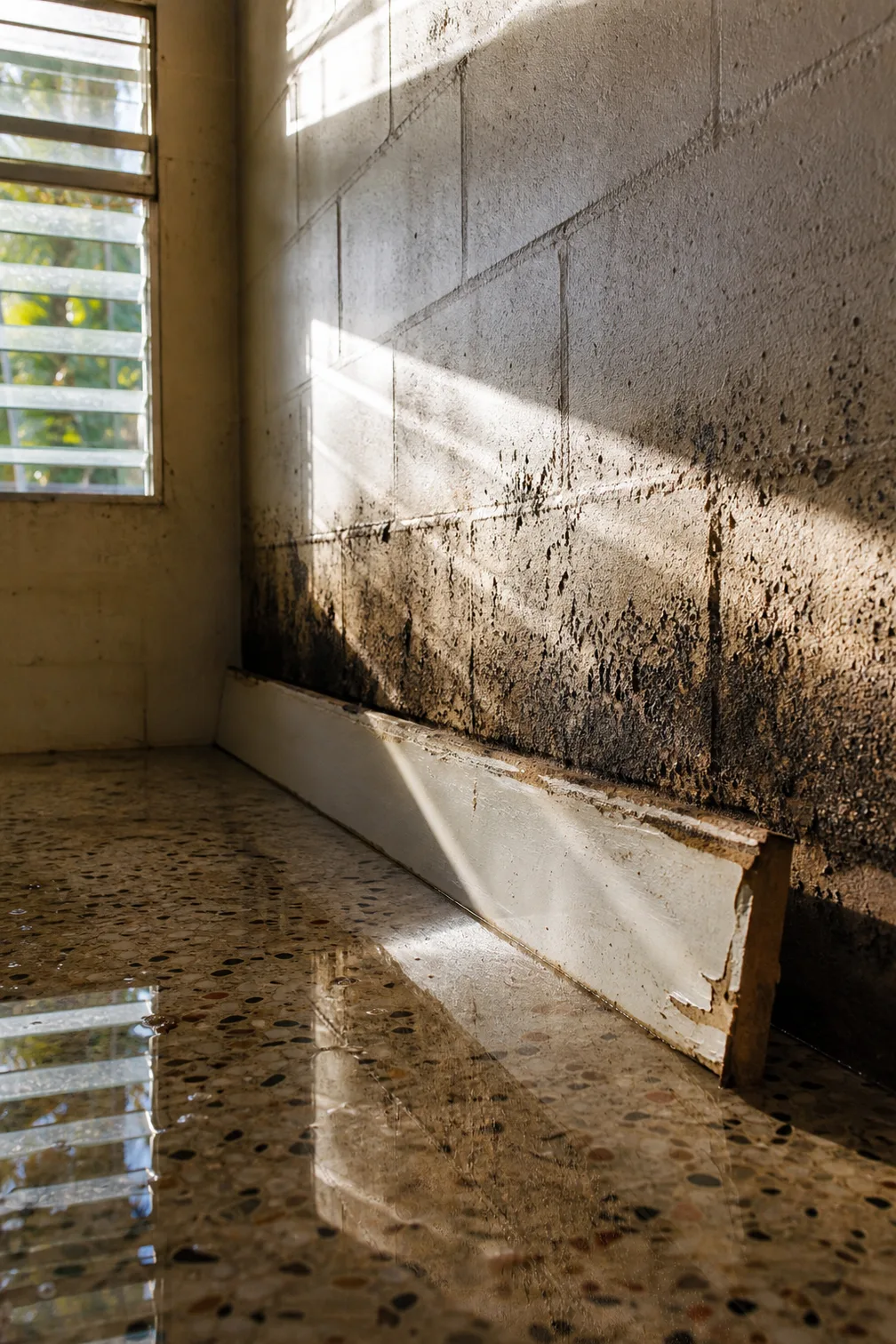
The visible patch on a wall face is the part that broke through. In a concrete-block house the growth is often on the back of the drywall or on the furring strips behind it, where the wall wicked water up from the floor and the air-conditioned room face stayed cool enough to condense. Nothing about the painted surface says so until it stains.
What finds it is a moisture map, a borescope through a small hole, or a thermal camera used to point at the cold wet area rather than to see the growth itself. What does not find it is a swab of the visible patch, because the visible patch was never the question.
That is also why an assessment that arrives without a moisture reading is worth querying. The measurement is the part that survives being disagreed with.
Black mold removal, and the word itself
There is no species called black mold. The phrase is usually aimed at Stachybotrys chartarum, which is dark and grows on cellulose that has stayed wet for a long time, but color is a poor guide in both directions: many dark growths are ordinary, and several species people would not worry about looking at are the ones that trigger reactions.
The method does not change with the color. It changes with the area, the material and whether the moisture has stopped. Writing a remediation plan from a photograph of something dark starts from the wrong information.
Mold inspection and mold testing: what each one buys
An inspection is somebody looking, with instruments. A test is a sample sent to a laboratory. They answer different questions and they are often sold as though they answer the same one.
Testing is most useful in two situations. When there is a smell and no visible source, a sample can confirm that something is growing somewhere before a wall is opened. And after remediation, a clearance test is the evidence the work was finished rather than stopped.
Testing is least useful as a first step on visible growth. If you can see it, the laboratory will tell you what you already know, and the money is better spent finding the water.
How to check a license yourself, before anything starts
This is the part of the page that no page-one competitor in this market publishes, and it takes about two minutes.
The Department of Business and Professional Regulation runs a public licensee search that covers the professions it regulates, mold assessors and mold remediators included. You can search by name or by license number.
Four things to do with it. Ask for the license number in writing rather than accepting a statement that the firm is licensed. Look the number up yourself rather than accepting a screenshot. Check that the name on the register is the same legal name as the one on the contract, because a license held by one entity does not cover a different one. And check it before any work starts rather than after, because once a crew is on site you have much less room to ask.
None of that is a claim about anybody we pass a request to. It is a check you can run on any contractor in this state, including one you found somewhere else.
Why it starts here in the first place
Mold needs moisture, a food source and time. This climate supplies the third generously and the first for six months of the year, so the only variable a homeowner actually controls is the second and the speed of the response.
The common starting points in this city are a supply line that leaked slowly behind a cabinet, an air conditioning condensate line that dripped into a wall or a ceiling cavity, and a room that stayed shut and unconditioned through the wet season. All three are slow, which is why the growth is usually established before anyone notices it.
Fixing the water is not part of a remediation quote unless it is written into one. Ask.
Where to go next
If the property is a condominium, the question of who pays arrives before the question of who does the work, and our condo water damage guide sets out how the allocation generally works in Florida. An allocation dispute is a question for a Florida community-association attorney rather than for a contractor.
The rest of this site is on water damage restoration in Hialeah and the services hub. Neighboring municipalities have their own pages, including Doral, with the full list on service areas.
A mold remediator, a company that employs a mold remediator … may not: … Use the name or title “certified mold remediator,” “registered mold remediator,” “licensed mold remediator,” “mold remediator,” “professional mold remediator,” or any combination thereof unless the person has complied with the provisions of this part.
In Florida the words on a mold company's van are regulated. The titles are reserved for people who have complied with this part of the statute, and the state keeps a public register of who has.
Fla. Stat. s. 468.8419(2)(c), read 2026-08-31Mold questions specific to Florida
-
Do you need a license to do mold remediation in Florida?
Yes. Florida licenses mold assessors and mold remediators as two separate occupations under chapter 468 part XVI of the Florida Statutes, and the Florida Department of Health points at the Department of Business and Professional Regulation as the body responsible for issuing them.
General water mitigation is not separately licensed in the same way, which is why a firm can dry your house without holding a mold license and still need one before it remediates.
-
Can the same company inspect and then remove it?
Not within twelve months, in either direction. The statute bars a mold assessor from remediating a structure their company assessed in the last 12 months, and bars a remediator from assessing a structure their company remediated in the last 12 months.
The statute carves out one group, contractors classified as Division I under section 489.105(3). If a single firm offers to do both, that is the question to ask them, and the answer should be specific.
-
What is the average cost of mold remediation in Florida?
It is set by area, by what has to be removed, and by whether an independent assessment and a clearance test are part of the job. A small surface patch on a hard wall is a different order of cost from opening a wall cavity across a room.
Ask whether the quote includes an assessment by a separate company, because that is the line most often left out and it is the one the statute pushes you towards. Our guide to what a Florida mold job costs sets out the four things that move the figure and what a published state policy form caps this category at.
-
What is black mold, and is it different?
There is no single organism called black mold. The phrase is usually pointed at Stachybotrys, which is dark and grows on constantly wet cellulose, but plenty of harmless species are also dark and plenty of harmful ones are not.
Color does not decide the method. Area and moisture do, which is why a remediation plan is written from measurements rather than from a photograph.
-
Should I get it tested?
A test tells you what is present and roughly how much. It does not tell you where the water is coming from, and stopping the water is what stops the growth. Testing is most useful in two situations: when you can smell it but cannot find it, and after remediation as a clearance check.
If you do test, the assessment should come from a company that is not going to bid for the removal, which is the arrangement the statute is built around.
-
Where can I find mold remediation services in Florida?
Anywhere, and the useful filter is the register rather than the advertising. The Department of Business and Professional Regulation publishes a licensee search that will confirm whether a name or a company holds a current mold license.
Ask for the license number, look it up before work starts, and check the name on the register matches the name on the contract.
Get a quote for mold remediation in Hialeah
Send what you have found and how large it is. One contractor working in this city will come back with what they would do, and you can check their license on the state register before anything starts.
Serving Hialeah and Miami-Dade County.